Skip to main
University-wide Navigation

About Academic Agreements

Academic agreements formalize partnerships that expand educational opportunities, support faculty collaboration, and advance the University of Kentucky's mission.

Whether you are developing a new academic partnership, exploring a student exchange opportunity, or renewing collaboration, the resources on this site can help you understand the process and identify the right steps.

Why Academic Agreements Matter

Academic agreements establish clear expectations and responsibilities for collaborations involving the University of Kentucky.

  • Support student success
  • Protect the interests of the university
  • Align with academic standards and accreditation requirements
  • Address financial, operational, and legal considerations
  • Establish clear roles, responsibilities, and expectations among partners
  • Advance the university's educational, research, and engagement missions
 
Getting Started

Not sure where to start? Use the resources below to identify the right next step.

Find Your College Contact

Your college's designated academic agreements representative is your first point of contact for questions and guidance.

Start an Agreement

Your designated college representative will coordinate submissions through the university's Academic Agreement process.

Understand the Process

Learn about university review, approval, and execution.

FAQs and Resources

Find answers to common questions about academic agreements and access guidance, templates, and supporting documents.


Questions?

The Office of Strategic Planning and Institutional Effectiveness (OSPIE) supports the university's academic agreements process and can help direct you to the appropriate resources.
Visit the Academic Agreements SharePoint

Designated college representatives may upload existing academic agreements directly to their college's folder in the Academic Agreements SharePoint site (UK credentials required).

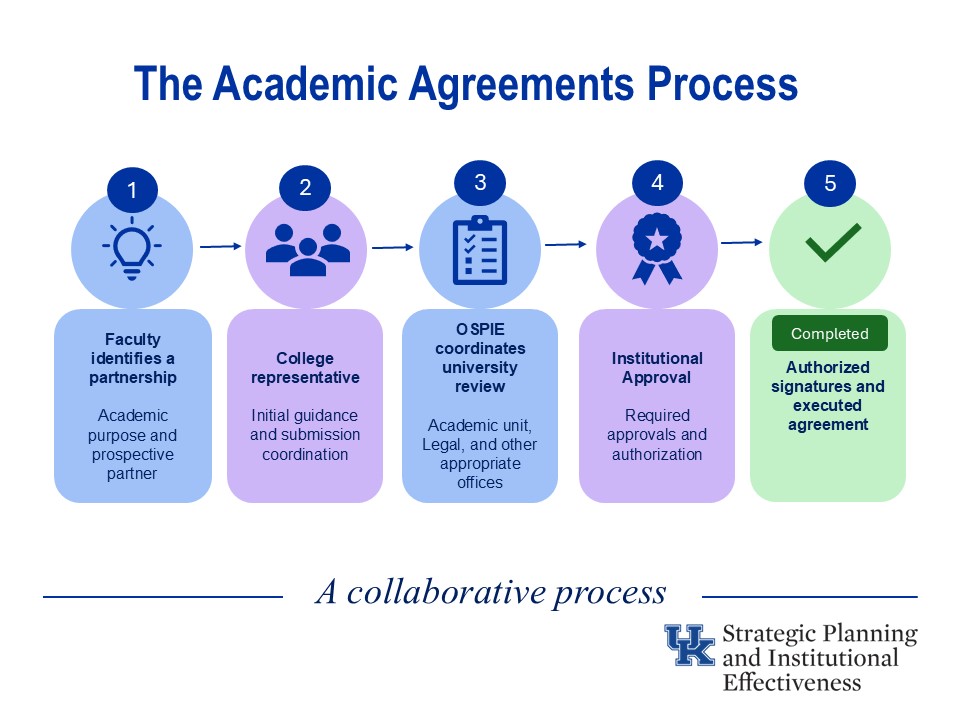
The Academic Agreements Process. 1) Faculty identifies a partnership. 2) College representative provides guidance and coordinates submission. 3) OSPIE coordinates university review. 4) Institutional approval 5) Completed

FAQ

Can I sign an agreement on behalf of UK?

No. Only individuals with appropriate delegated signing authority may execute agreements on behalf of the university.

Can I use a partner's agreement?

Yes, but it must go through the appropriate university review process.

Can I send an agreement directly to Legal?

The agreement should first be coordinated through the designated college representative and OSPIE process.

How long does review take?

Allow at least two weeks, and longer when an agreement involves complex academic, financial, legal, or accreditation considerations. 

Can I begin the partnership before the agreement is signed?

Faculty should not make commitments or represent that an agreement is approved before the university's required review and approval are complete.

A student is currently employed at a placement site. Is an academic agreement required?

Yes. An academic agreement is required when a student receives academic credit for a placement. These agreements help ensure that expectations and responsibilities are clearly defined for the student, the university, and the placement site, including matters related to student privacy, liability, supervision, and conduct.

Does my academic agreement need to be reviewed by the Provost Office or UK Healthcare?

Please consult your college representative. In general, placements involving access to protected health information, patient records, clinical systems, or other healthcare-related requirements may need to be reviewed by UK Healthcare.

Can you please explain the difference between faculty responsibilities and university responsibilities?

Faculty/Academic Unit College Representative OSPIE/University Offices
Identify the potential partnership Help identify the appropriate agreement pathway Coordinate institutional review
Define academic purpose and activities Coordinate submission Review for accreditation considerations
Provide information needed for review Track and facilitate the submission Coordinate with legal and other offices
    Facilitate approval